
Robotics · Physical AI · Market development
Robotics is moving from fixed automation to systems that perceive, move and adapt
A business-oriented knowledge center on industrial robots, cobots, mobile systems, humanoids, service robotics and physical AI—what works today, what remains in pilot stage and where Brazil and Latin America fit.
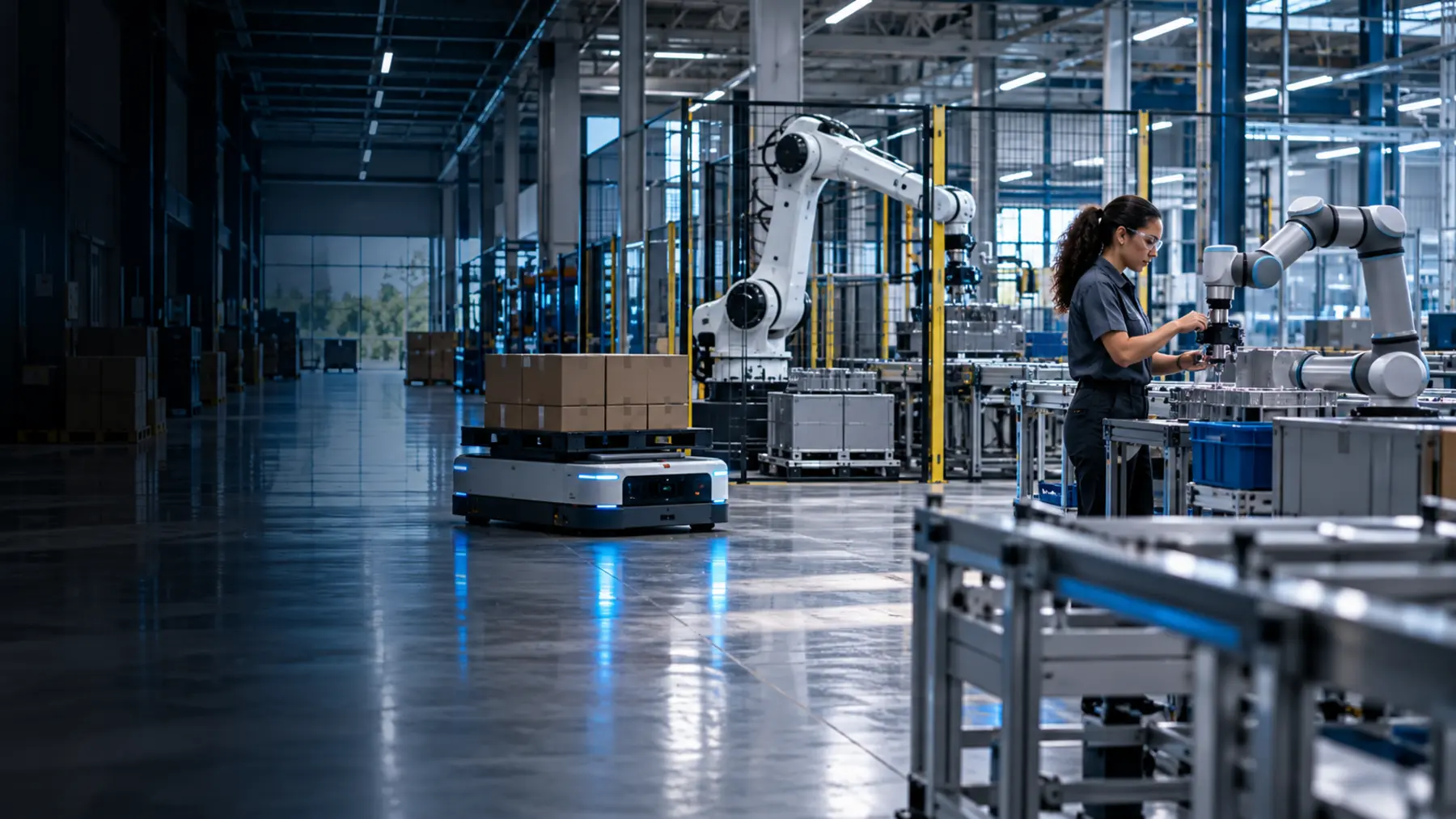
AI-generated conceptual illustration; it does not depict a specific commercial product.IFR · World Robotics 2026
Market snapshot
The global market is expanding, but maturity differs by robot type and application.
IFR Industrial Robots, 24 Sep 2026 · IFR Service Robots, 30 Sep 2026
Robotics
Explore by category
01
Industrial & collaborative robotics
Assembly, welding, inspection, packaging and palletizing.
→02Mobile robotics & logistics
AMRs, AGVs, fleets and enterprise integration.
→03Humanoid robots
Demonstrations, pilots, commercial availability and limitations.
→04Service & medical robotics
Cleaning, hospitality, inspection, surgery and rehabilitation.
→05Field & special environments
Agriculture, mining, energy, construction and hazardous operations.
→06AI applied to robotics
Vision-language-action models, simulation, edge and GPUs.
→In-depth briefings
Evidence before enthusiasm
The evolution of robotics: what works, what is advancing and what still needs to mature
Robotics progress is real, but maturity differs sharply between repeatable industrial cells and general-purpose machines operating in changing environments.
Read article →Industrial robots and cobots: selecting the right operating model
The choice is not “robot or cobot”; it is the safest and most productive architecture for a specific process.
Read article →AMRs, AGVs and the operating reality of mobile robotics
Mobile robots create value when navigation, traffic, payload transfer and warehouse systems are engineered as one flow.
Read article →Humanoid robots: separating demonstrations, pilots and commercial deployment
Humanoids can use spaces designed for people, but general-purpose operation remains harder than a compelling demonstration suggests.
Read article →Selected official videos
Manufacturer and platform demonstrations, each with context on maturity and autonomy.
06International events
Verified upcoming editions, dates and official links.
07Companies and platforms
Independent editorial profiles; no partnership is implied.
Technology timeline
From fixed automation to physical AI
1961
Unimate enters automotive production at General Motors, establishing industrial robotics.
1973
KUKA Famulus demonstrates a six-axis electromechanical industrial robot architecture.
2008
Universal Robots begins commercializing lightweight collaborative robot arms.
2012
Mobile warehouse robotics accelerates after Amazon acquires Kiva Systems.
2015
ABB introduces dual-arm YuMi for collaborative small-parts assembly.
2020–2023
AMRs, vision and easier programming broaden adoption beyond automotive production.
2024
Electric humanoid platforms and NVIDIA Project GR00T intensify physical-AI development.
2025
IFR records 5 million industrial robots operating globally.
2026
Physical AI, humanoid pilots and service robotics expand, while safety and business-case limits remain visible.
Brazil and Latin America
How to evaluate a robotics project
Adoption depends on an operational problem, local integration and support, and an acceptance plan—not only on access to hardware.
Read article- Define the operational problem and baseline
- Validate technical feasibility and integration
- Assess safety, data and regulatory requirements
- Model total cost and conservative benefits
- Pilot with acceptance and failure criteria
Robotics · Brazil · LATAM
Explore robotics opportunities in Brazil and Latin America
Evaluate channels, partners and commercial opportunities with local context and a practical route to market.